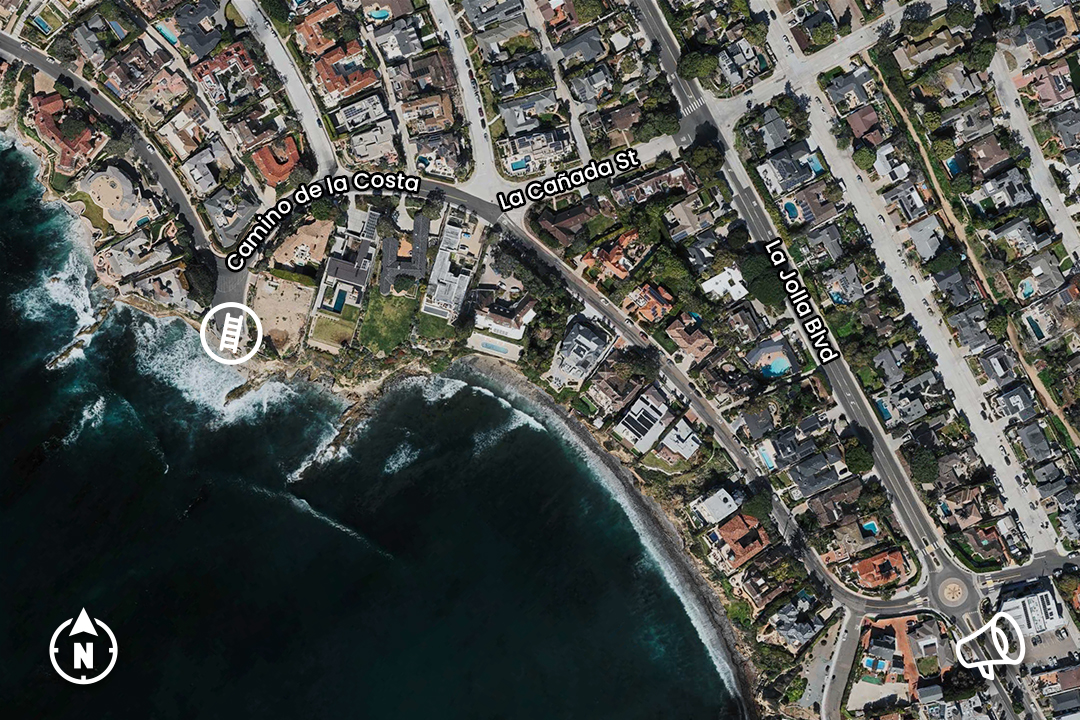
The project has been in progress for years, exploring ways to repair the beach access stairway and make potential improvements to the scenic overlook and parking area adjacent to the address.

The 50-foot stairway, built in 1984, has disintegrated over time, due to coastal erosion and stormwater runoff, raising concerns for some time about its structural integrity and safety. Most of the original metal handrail no longer exists, as the stairs are crumbling, exposing jagged edges.
The California State Coastal Conservancy unanimously authorized $325,000 to the city of San Diego to conduct a feasibility study for the project in November 2023.
The feasibility study, completed April 15, identifies three ways to address the problem: rehabilitation of the existing staircase; reconstruction of the staircase with the same starting point; and reconstruction of the staircase with an 18-inch setback.
Each option can be done with a metal pipe railing system or a concrete wall handrail, the report states.

Advantages of rehabilitation of the existing staircase include its being the least expensive alternative, according to the study, at $650,000 with the metal railing.
Rehabilitation would take 48 work days; the cost goes up to $935,000 and adds 12 work days with a concrete handrail.
The disadvantages of this plan include continued deterioration of the 40-year-old concrete.
Reconstruction of the staircase at the same starting point would cost $920,000 with a metal handrail and $1,205,000 with concrete handrail, and work would be 58 to 70 work days, the study states. Advantages of this plan include its having the longest service life, constructed for 50-year durability. The disadvantages are it’s the most expensive plan and would have the smallest lookout area at the bottom landing.

Reconstruction of the staircase but with an 18-inch setback would cost $910,000 with a metal handrail and $1,195,000 with concrete handrail, and work would also be 58 to 70 work days.
An 18-inch setback was determined to be the optimum amount with consideration for the impact of excavation and potential undermining of the existing staircase.
This plan would carry the same durability but have a larger lookout area, the study states.
Due to these advantages, along with being slightly less expensive, the authors of the feasibility study recommended the third alternative, with the concrete barrier as it’s “most preferred … as they will have the strength to withstand coastal forces and require lesser maintenance demands of the city.”
The report also recommends erosion mitigation measures be incorporated at the project site to improve
the durability and longevity of the bluff and stairway, which would cost $408,000 and take 10-15 concurrent work days.
Though additional details on the future of the Camino de la Costa stairs project are not available from the city, according to city spokesperson Tyler Becker, Parks and Recreation Department staff have initiated work to install a temporary handrail.
That work has been approved and is scheduled to start Monday, May 12, Becker said, to address immediate needs regarding the stairs.
© lajolla.ca