The second in this lajolla.ca series examines local regulations for creating more housing density, the role of historicity and perceived abuse of the law.
Welcome to the next in “In the zone,” a lajolla.ca series that dives into the broad range of topics concerning housing density in La Jolla, with voices including proponents and critics and more.
With identified housing shortages plaguing the city of San Diego and statewide, officials are exploring many ways to increase density, including throughout La Jolla.
Some of these methods include a new ballot measure to tax owners of empty houses (La Jolla has a large percentage of the city’s vacant second homes) and changes to minimum lot size and facilitation of the construction of mid-rise housing.
Other methods take into account the historicity of significant buildings in the city, while other regulations offer bonuses for certain design components.
Each method has its perceived potential for success or failure, as explored below.
Good foundations?

A construction site at the former Su Casa restaurant location on La Jolla Blvd., where 16 residential units — including seven ADUs and one retail space — are planned as part of the Su Casa Residences development.
To encourage an increase in housing density, the city adopted the Complete Communities initiative in 2019, with a Housing Solutions program incentivizing construction near high-frequency transit lines.
Incentives include expedited application processing; a waiver of floor-area ratio maximums; fee waivers; parking requirement waivers; height limit waivers; and more.
Projects qualify for incentives if they fall inside a “transit priority area,” within a half mile of a public transit stop; and include a percentage of units affordable to very low income, low income, or moderate income households.

There are various tiers for each qualification, incentive and wavier, with recent updates to the regulations to include allowances for off-site or delayed construction of the affordable units.
Further California legislation has enhanced density bonuses with similar requirements for proximity to transit and affordability, with newer regulations overriding local governance, extending transit areas to be within a mile of access and other stretches.
Where La Jolla fits
In La Jolla, the areas zoned for higher density are also within a transit priority area: Parts of La Jolla Shores closest to the ocean; The Village and south through Windansea and Bird Rock to Pacific Beach; and along North Torrey Pines Road, hugging UC San Diego past Torrey Pines Golf Course.
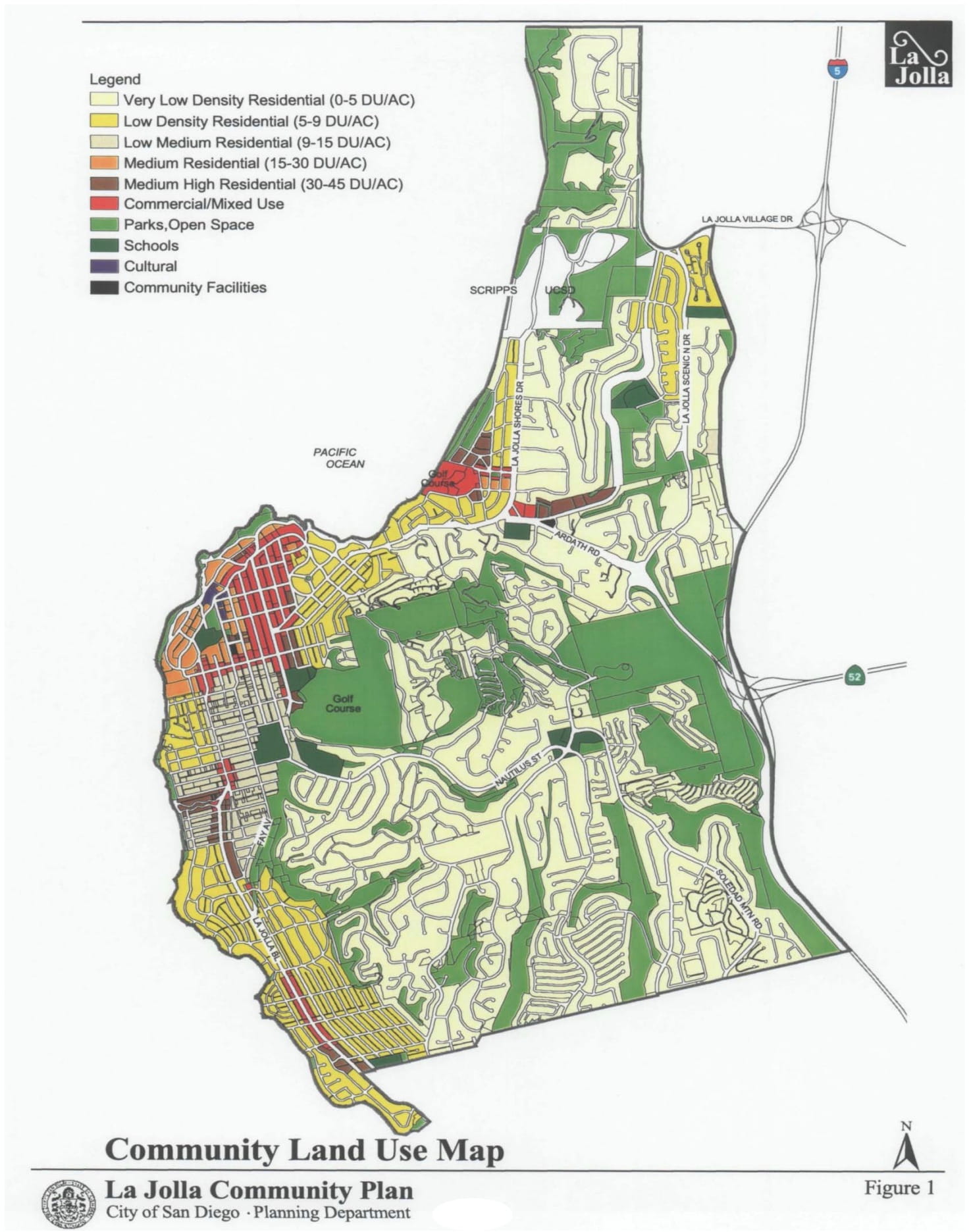
In those neighborhoods, however, public transportation means the San Diego MTS Line 30 (Old Town to UTC via Pacific Beach), which runs north-south via Torrey Pines Road, Pearl Street and La Jolla Boulevard.
In theory, reducing parking and increasing density in the transit priority areas is “a good thing,” LJCPA President and La Jolla architect Lisa Kriedeman said.
In practice, however, that can mean multi-unit buildings built several blocks from a bus stop, from which the bus still has to navigate the traffic in and out of La Jolla.
The waivers and bonuses “are really good for certain areas where the infrastructure is there to take the onslaught of the traffic,” Kriedeman said, adding that having a bus line isn’t “really a transit zone. If you’re on a trolley, that’s a true transit zone.”

La Jolla does have one trolley stop, at the edge of La Jolla’s borders at Nobel Drive and Interstate 5, a 40- to 45-minute bus ride from Bird Rock and about a 30-minute bus ride from Prospect Street in The Village.
The bus line nonetheless qualifies development in these areas for incentives as long as they follow requirements for affordable housing and abide by the 1972 coastal height limit imposed by Proposition D, which limits buildings to 30 feet in La Jolla and all coastal areas west of Interstate 5.
Some, however, feel the incentives aren’t enough and more effort is needed to move density in the right direction.
Calling the 1972 coastal height limit “the most significant barrier” to housing density, La Jollan and LJCPA member Harry Bubbins said Prop D “now acts as a citywide constraint on sensible housing” affecting affordable projects both within and beyond the coastal zone.

Others point to projects like the much-resisted “Turquoise Tower,” a development called “Vela” just outside La Jolla that would build a 23-story, privately-funded high rise leveraging several of the density bonuses and waivers, as an abuse of exemptions for profit.
Vela “would mostly function as a hotel, and will not help address the affordable housing crisis in San Diego’s coastal communities,” San Diego Mayor Todd Gloria and City Council President (then Pro Tem) Joe LaCava stated in a 2024 letter.
La Jolla leaders have expressed concern Vela would set a precedent paving the way for similar development in La Jolla.
Honoring La Jolla’s historic structures

This historic building is being converted to residential, showing how historic homes can provide new housing without new construction.
The answer to increasing housing density in La Jolla may lie not in building up, but within, according to some, as many structures in La Jolla are historic, providing a preservation and appreciation of history.
Historicity, however, can come with a perception of limits, as historic designations are tied to strict regulations regarding construction.
But “preservation is being scapegoated wrongly,” said David Goldberg, who leads the San Diego-based Save Our Heritage Organisation, which recently engaged in a study to examine historicity’s effect on density.
Preservationists feel the city has not done enough to address the loss of existing, affordable housing, Goldberg said, whether through conversions to short-term vacation rentals and the demolition of older homes for the construction of market-rate housing.
“If you want to talk about affordable housing, it’s not just building new units,” he said. It’s using what’s already in existence.
“Adaptive reuse,” or converting older buildings into residential uses, has been employed by the city, however, to increase housing supply, though there is still more to be done.
And in many cases, Goldberg said, the trend is to build, when adaptive reuse is a much cheaper alternative.
In La Jolla, historic homes can be added on to and in many cases, take on interior updating that does not negate the historicity.
“Just because it’s historic doesn’t mean you can’t add to it,” Kriedeman said.
And La Jolla has plenty of original cottages that are, “smaller, affordable housing next to a major transportation corridor,” Goldberg said.
The affordability issue

Looming over any discussion of housing in La Jolla, however, is the term “affordable,” which in 92037 is different from the rest of the city due to higher incomes and much higher real estate prices.
“Affordable housing opportunities in the community have been reduced as a result of increased land costs and a decrease in residential densities,” the La Jolla Community Plan states.
And when builders take advantage of density bonuses by including low income units, those unit percentages are based on the area median income, which for San Diego County, is $130,800 for a family of four; a single person earning $92,700 is considered low income.
San Diego defines affordable housing as rent price being no more than 30% of monthly income; for a family earning AMI, that’s $3,270 a month.
As of December, the median rent price in La Jolla is $8,000 a month, according to realtor.com, with the median home price just over $3 million.
In La Jolla, “you’re already in a beach area where the rents are higher than, say, inland,” Kreideman said. “It’s not all that affordable”
And bulldozing to build creates “affordable units [that] are probably more expensive than what was there before,” Goldberg said.
Future installments will dig into local opposition and perceptions of density. To read the previous installment of “In the zone,” click below: