


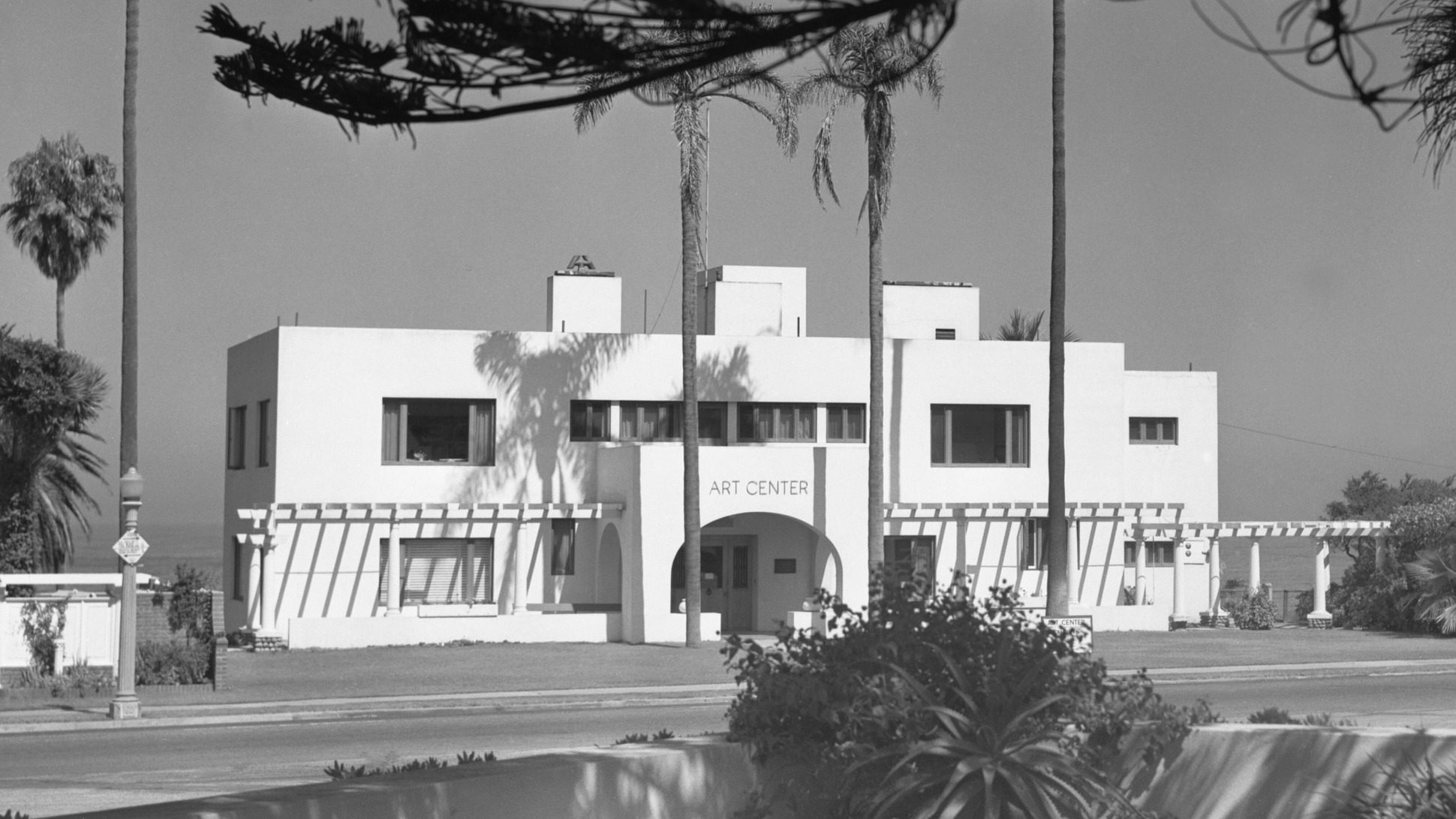


Original construction
In 1896, “Miss Ellen Browning Scripps bought two lots on the ocean side of Prospect Street, nearly opposite Draper Avenue,” according to Howard Randolph’s 1995 book “La Jolla Year by Year.”
The land cost Scripps $800, or $23,000 in 2016 dollars, historian Molly McClain wrote in her biography of Scripps.
Work began on the Scripps home, named “South Molton Villa” for the London street Scripps was born on, in 1897.
Reconstruction

South Moulton Villa (pre fire), date unknown
La Jolla Historical Society
The original structure succumbed to fire in 1915, saved by firefighters from “complete destruction” but still leaving Scripps temporarily without a home, McClain wrote.
The fire was deliberately set by William Peck, who had done house cleaning and other odd jobs on the estate and confessed to the arson, saying he had been drinking and wanted to exact revenge on the housekeeper who had fired him that year.
Scripps commissioned architect Irving Gill, whom she had contracted with for many La Jolla projects, to rebuild South Molton Villa “not as a show place but a structure that could be used by the community of La Jolla after her death,” McClain wrote.

Scripps’ home, 1932
La Jolla Historical Society
The new residence, built between 1915 and 1916, became known as one of Gill’s great works, a three-story, concrete structure with a large arched front porch.
That arch is a signature of Gill’s style, replicated in the neighborhood structures such as at the La Jolla Recreation Center, the inspiration for murals about town and recognizable in future iterations of South Molton Villa.
Scripps died at her home on Aug 3, 1932, after declining to leave an endowment for the estate’s upkeep.
Birth of an art center
MCASD as it is now “began as a wish in November 1940,” according to the Online Archives of California via the La Jolla Historical Society.

Poster announcing National Art Week, Nov. 25 to Dec 1.,Work Projects Administration Poster Collection
Library of Congress
President Roosevelt proclaimed National Art Week with the slogan “American Art in Every American Home,” and La Jolla’s participation in the initiative “focused on exhibitions by members of the La Jolla Art Association,” displayed in South Molton Villa.
“Out of this successful exhibit came the idea of acquiring the home of Miss Scripps as a permanent exhibition space,” according to OAC.
“Some of the artists of The Village felt that there should be an art center in La Jolla,” Randolph wrote, “a place where the work of local and nearby artists could be shown [in] a gathering place for those of artistic tastes.”
A society was formed and fundraised, he wrote, to purchase South Molton Villa in 1941, which became The Art Center in La Jolla.
Transition to museum

Theodor Seuss Geisel, known as Dr. Seuss, is pictured at the La Jolla Art Center in 1964
San Diego History Center
After successive modifications by architects Robert Mosher and Roy Drew to add formal galleries in 1950, name changes to La Jolla Museum of Art in 1964 and La Jolla Museum of Contemporary Art in 1971 and more renovations by Mosher and Drew in 1980, the building became the Museum of Contemporary Art San Diego in 1992.
Architects Venturi, Scott Brown and Associates spearheaded a 1996 expansion and renovation as the museum continued to grow until 2017, when it closed to undertake its most ambitious redo yet.
MCASD overhaul
 The arches remained a focal point of the recent renovation, a $105-million endeavor by Selldorf Architects that quadrupled the existing gallery space from almost 10,000 square feet to 40,000 square feet, resulting in a 105,000-square-foot footprint as artful as that which it exhibits.
The multiyear reconstruction retained the Gill arches as well as framing the ocean behind the building; MCASD is known now as a current purveyor of art in all forms to a wide audience from all over.
Craving more views on La Jolla’s art scene? Check out our blog here.
© lajolla.ca


